

Lecture Description
Coffee extracts contain thousands of different compounds, many of which contribute to the quality of the cup. Minor fluctuations in the ratios of these compounds give rise to major differences in perceived flavor. However, to date, the industry is only able to measure the average total solvated mass (%TDS) or use cost-prohibitive and slow chromatography methods. Electrochemistry offers a route to measuring coffee components in real time and provides insights into both the quantities of compounds and their identities.
Together, our approach provides unparalleled insight into what is solvated in the cup, and we further explore how the same technique can be used to modify flavor. This talk will cover the fundamentals of electrochemistry, demonstrate its utility, and present a real-time demonstration. This work is supported by the Cottrell Scholars Award and the Coffee Science Foundation, in partnership with Nuova Simonelli.
Date: Friday, June 26, 2026
Time: 13:00 - 13:45
Location: Room 1122
Category: Science
Access: This lecture is free to attend with a World of Coffee entry badge. Register to attend World of Coffee here.
Please note that lecture sessions are open on a first-come, first-served basis. Early arrival is highly recommended to secure your seat.
Speaker
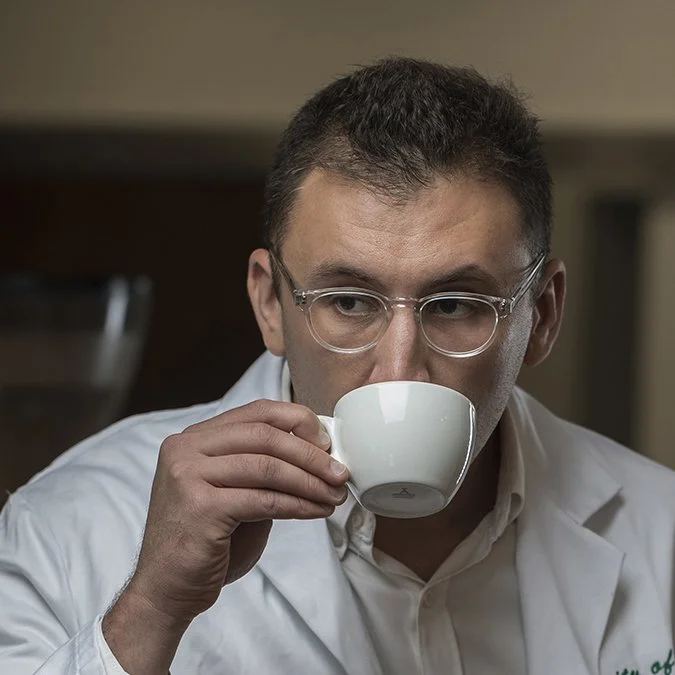
Christopher Hendon
Professor, University of Oregon
Prof. Christopher Hendon is a computational chemist with interests in energy materials and coffee extraction. He obtained his BSc. Adv. HONS from Monash University (2011) and PhD from the University of Bath (2015). After a two-year postdoc at Massachusetts Institute of Technology, he joined the University of Oregon in 2017, where he is now an Associate Professor of Chemistry. He has published over 150 papers, was named a Cottrell Scholar in 2021, a Camille Dreyfus Teacher-Scholar in 2022, the Samuel R. Scholes Jnr. Lecture for excellence in scientific communication, and has been awarded the Rippey Award for Innovative Teaching. In coffee, he authored Water For Coffee and has written numerous peer-reviewed articles on the topic. He is also a founder of Overpotential, a startup that uses electricity to modify flavors in drinks.